
Is 96% Alumina Metallized Ceramic Suitable for Bonding and Welding?
Engineers frequently choose 96% alumina metallized ceramic for its excellent electrical insulation, mechanical strength, and cost-effectiveness. When joining these parts to metals—such as in vacuum feedthroughs, sensors, or power electronics—the common question arises:
Can 96% alumina be bonded or welded directly to metals?
The answer: 96% alumina is highly suitable for ceramic-to-metal joining via metallization and brazing, but direct welding of the ceramic is not practical. "Welding" typically applies only to the metal portions after brazing.
This guide explains why 96% alumina excels in these applications, outlines key processes, and provides practical considerations.
1. What Is 96% Alumina Ceramic and Why Is It Popular?
96% alumina (Al₂O₃) ceramic contains about 96% aluminum oxide, with 3–4% glassy phase additives (e.g., SiO₂, CaO, MgO) that enhance sintering and mechanical properties.
Reasons for popularity:
- Cost-effectiveness — Raw material costs $12–18 per kg, up to 86% cheaper than 99.5%+ purity alumina.
- Balanced performance — High dielectric strength, good thermal conductivity, and mechanical robustness.
- Metallization compatibility — Glassy phase promotes strong adhesion for traditional metallization processes.
These properties make 96% alumina ideal for metallization in ceramic-to-metal joining.
2. Common Metallization Processes for 96% Alumina Ceramic
(1) Moly-Manganese (Mo-Mn) Process
- Most common and reliable for 96% alumina.
- Steps: apply Mo-Mn paste → high-temperature firing (1350–1500°C) → optional nickel plating for braze compatibility.
(2) Other Methods
- Thick film printing (Ag-Pd) — lower temperature (850–950°C), moderate bond strength.
- Active metal brazing — uses alloys that bond directly without separate metallization, at 800–950°C.
Technical Comparison:
| Method | Temperature (°C) | Bond Strength (MPa) | Hermeticity | Typical Applications |
|---|---|---|---|---|
| Mo-Mn (with Ni) | 1350–1500 | 85–110 | <1×10⁻¹² atm·cm³/s | High-reliability hermetic seals |
| Thick Film (Ag-Pd) | 850–950 | 45–60 | <1×10⁻⁸ atm·cm³/s | High-volume, lower hermeticity needs |
| Active Metal Brazing | 800–950 | 70–90 | <1×10⁻¹⁰ atm·cm³/s | Direct brazing without separate step |
3. Bonding Metallized 96% Alumina to Metal
Metallized 96% alumina forms robust, often hermetic bonds via high-temperature brazing:
- Alloys: Ag-Cu eutectic or Au-Ni
- Temperature: 800–1000°C
- Atmosphere: Controlled (vacuum or inert)
Advantages of brazing:
- High joint strength (75–95% of base metal)
- Excellent hermeticity for vacuum applications
- Success rates exceeding 98%
Brazing vs. Direct Welding
| Parameter | Brazing | Direct Welding to Ceramic |
|---|---|---|
| Temperature | 800–1000°C | 1500–3000°C |
| Thermal Shock Risk | Low | Extremely high |
| Residual Stress | 120–180 MPa | 400–600 MPa |
| Joint Strength | 75–95% of base metal | <40% (if it survives) |
| Success Rate | ~98.7% | <12% |
4. Can You Weld Metallized 96% Alumina Ceramic Directly?
Direct welding of alumina ceramic—even metallized—is not practical or reliable:
- Ceramics are brittle
- Low thermal shock tolerance
- CTE mismatch with metals
In practice, "welding" refers to standard metal-to-metal welding (TIG, laser) on the metal flange after brazing the ceramic.
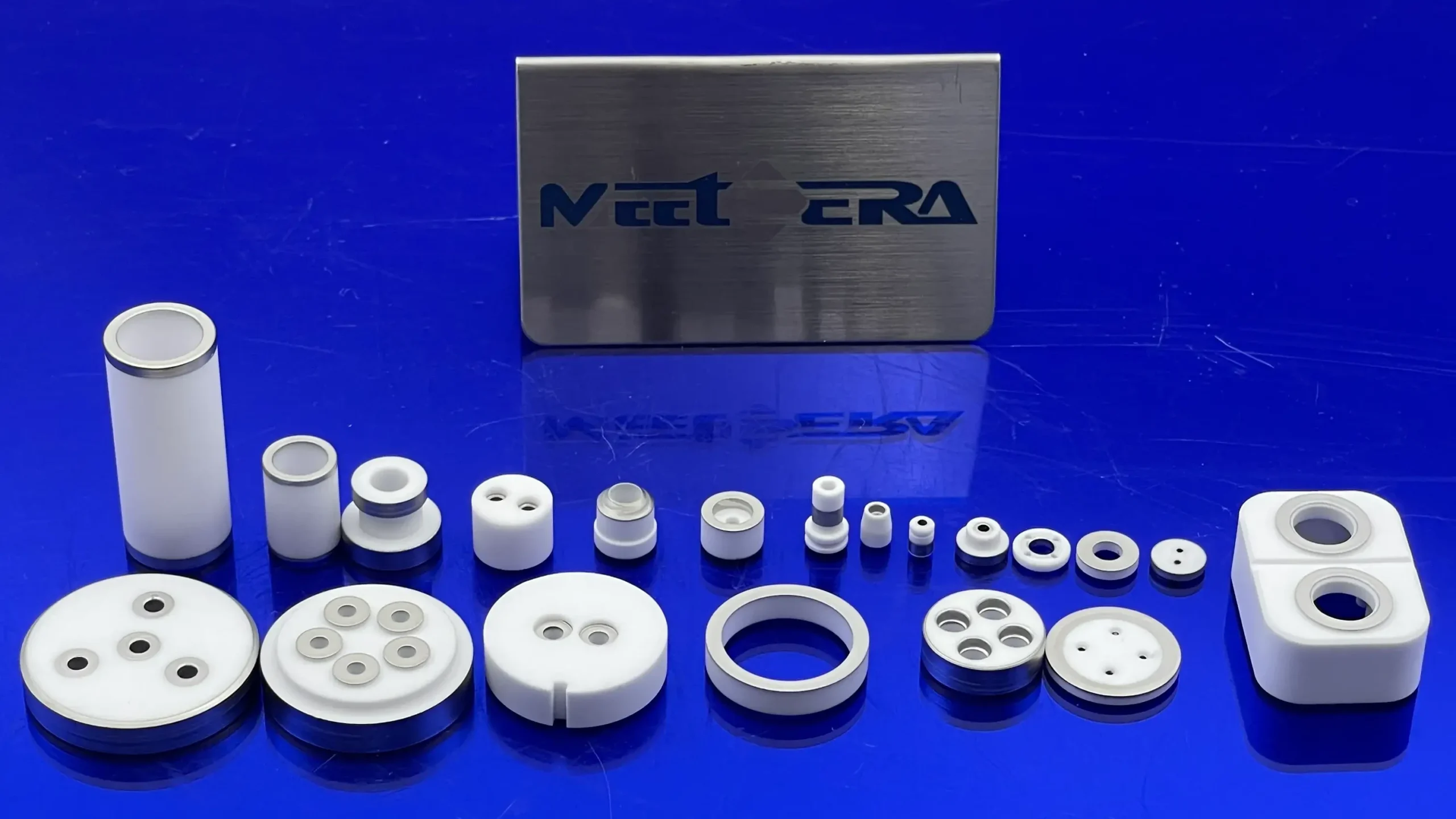
5. Applications of Metallized 96% Alumina Ceramic
- Vacuum feedthroughs and hermetic seals
- High-voltage insulators
- Sensors and transducers
- Power electronics and RF windows
- Medical devices and aerospace components
Benefits: Reliable ceramic-to-metal bonding in demanding environments.
6. FAQ
Q: Is direct welding possible on 96% alumina?
A: No — brazing is the reliable method; direct welding risks catastrophic failure.
Q: What is the best metallization method for 96% alumina?
A: Mo-Mn process, due to excellent adhesion and hermeticity.
Q: How does 96% alumina compare to 99.5% alumina for brazing?
A: 96% is easier to metallize and much cheaper, sufficient for most applications; 99.5%+ suits extreme-performance requirements.
7. Conclusion
96% alumina metallized ceramic is a cost-effective and reliable choice for ceramic-to-metal joining. Its balanced mechanical strength, thermal stability, and metallization compatibility make it ideal for brazing applications, providing high joint strength and excellent hermeticity.