
What Is a Ceramic Feedthrough for Implantable Medical Devices?
In recent years, electrical stimulation therapy has seen rapid growth in medicine and has become a key treatment approach for conditions such as Parkinson’s disease, epilepsy, chronic pain, and cardiac arrhythmias. From cochlear implants and deep brain stimulators (DBS) to cardiac pacemakers, implantable cardioverter-defibrillators (ICDs), emerging bionic eyes, and various neuromodulation devices, these active implantable medical devices (AIMDs) are dramatically improving patients’ quality of life.
Behind the reliable long-term performance of all these devices lies one small but absolutely critical component: the implantable ceramic feedthrough (also known as medical-grade ceramic feedthrough or hermetic ceramic feedthrough connector).
So, what exactly is an implantable ceramic feedthrough? Why is it often called the “lifeline” of implantable medical devices? This article explains it in detail.
1. What Is an Implantable Ceramic Feedthrough?
An implantable ceramic feedthrough is a precision-engineered hermetic connector that combines ceramic insulation and metal components. Designed specifically for active implantable medical devices, it acts as an intelligent barrier that simultaneously performs three essential functions:
- Bi-directional electrical signal transmission — reliably delivering stimulation pulses from the external controller to the implanted electrodes, or transmitting sensed bioelectric signals back to the internal electronics;
- Hermetic sealing — preventing body fluids and moisture from entering the device interior, which would otherwise cause circuit shorts, corrosion, or catastrophic failure;
- Electrical insulation and EMI filtering — maintaining high insulation resistance between multiple conductors while suppressing electromagnetic interference (EMI) to ensure clean signal integrity.
In simple terms, the ceramic feedthrough serves as both the “electrical pathway” and the “waterproof wall” that penetrates the device housing. If this component loses hermeticity or insulation integrity, the entire implant can fail within months — potentially endangering the patient’s life. That is why it must pass extremely stringent biocompatibility and reliability testing and comply with standards such as ISO 10993-1:2018 for biological evaluation of medical devices.
2. Core Functions and Application Areas
The primary functions of a medical ceramic feedthrough can be summarized as “conduct, isolate, protect”:
- Conduct — dependable transmission of therapy and sensing signals;
- Isolate — high dielectric strength between pins and effective EMI filtering;
- Protect — ultra-low helium leak rate (typically < 10⁻⁹ atm·cc/s He) to shield internal batteries, ASICs, and circuits from bodily fluids.
It is a core component in the following classes of implantable medical devices:
- Cochlear implants — transmitting encoded auditory signals;
- Deep brain stimulators (DBS) — precise modulation for Parkinson’s, essential tremor, epilepsy, etc.;
- Spinal cord and peripheral nerve stimulators — chronic pain management;
- Cardiac pacemakers and implantable cardioverter-defibrillators (ICDs) — maintaining normal heart rhythm;
- Ventricular assist devices, total artificial hearts, retinal prostheses (bionic eyes), and other cutting-edge neurotechnologies.
Take a cardiac pacemaker as an example: the ceramic feedthrough safely routes pacing pulses from the internal circuitry through the titanium case to the myocardial leads while blocking fluid ingress — helping the device achieve a service life of 10+ years. For deeper insights into the engineering considerations behind such devices, see this comprehensive review: Development of Implantable Medical Devices: From an Engineering Perspective.
3. Extremely Stringent Performance Requirements
Because these feedthroughs remain implanted for 10–20 years or longer, they must meet exceptionally demanding specifications:
(1). Excellent biocompatibility and corrosion resistance — materials must pass rigorous biological safety testing with no inflammation or rejection;
(2). Ultra-high hermeticity — preventing ingress of water vapor or body fluids that would destroy electronics;
(3). Resistance to thermal shock — capable of withstanding laser welding to titanium housings (hundreds of °C instantaneous peaks);
(4). Superior insulation and filtering performance — high dielectric withstand voltage and integrated feedthrough capacitors for EMI suppression;
(5). Mechanical robustness and long-term reliability — surviving thermal cycling, vibration, mechanical shock, and chronic in-vivo stresses.
These requirements far exceed those of industrial ceramic feedthroughs and represent one of the most challenging “bottleneck” technologies in medical device manufacturing. Advanced designs, such as capacitive feedthroughs, continue to push boundaries for size reduction and performance — as detailed in this peer-reviewed paper: Capacitive Feedthroughs for Medical Implants.
4. Typical Structure and Components
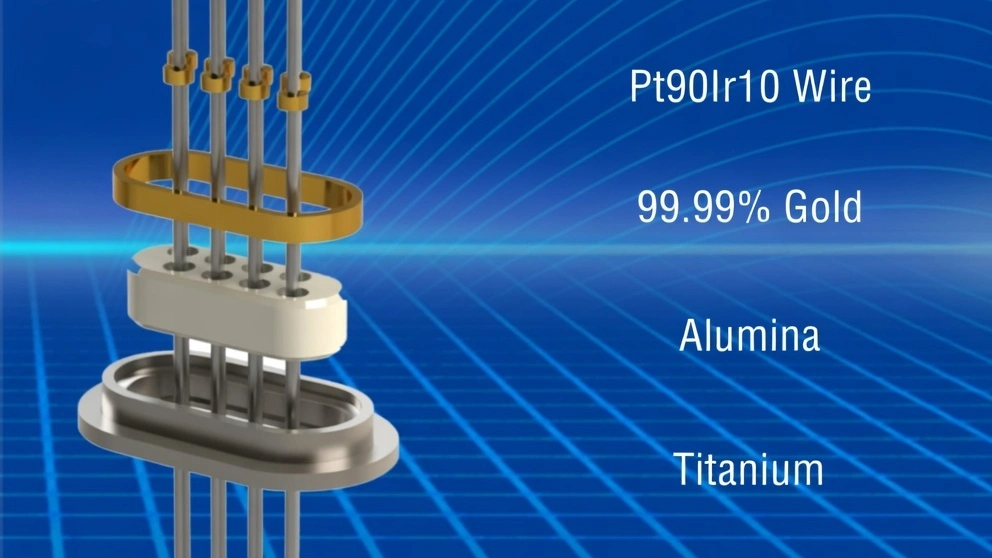
A standard implantable ceramic feedthrough consists of the following key elements:
| Component | Typical Materials | Primary Function | Key Performance Requirements |
|---|---|---|---|
| Outer metal flange | Medical-grade titanium or titanium alloys | Structural support and laser welding interface | High strength, biocompatibility, corrosion resistance |
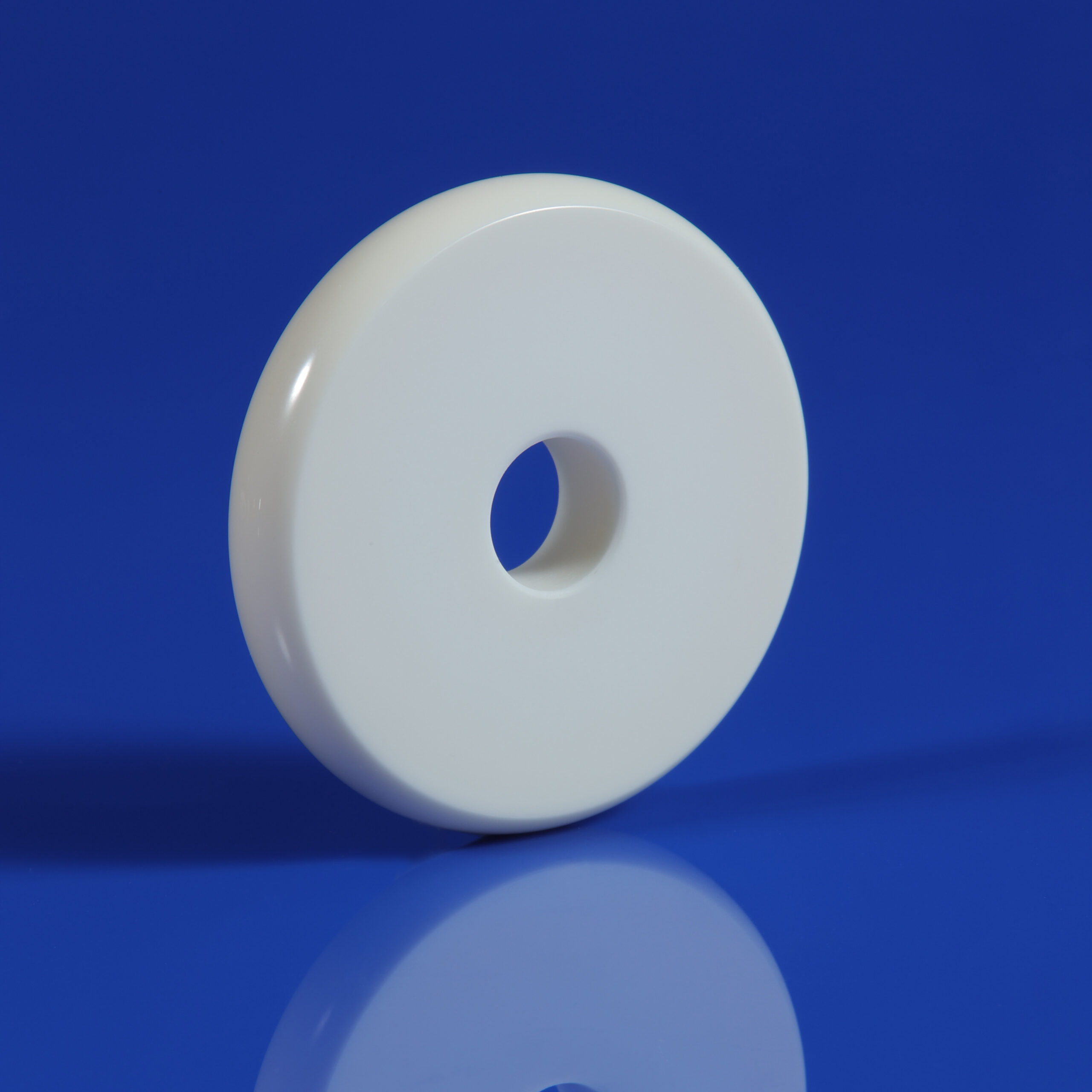
| Ceramic insulator | High-purity alumina (Al₂O₃ >96%), ZTA | Electrical insulation, hermetic seal, EMI filter base | Excellent dielectric strength, mechanical toughness, hermeticity |
| Braze / seal material | Pure gold, gold alloys, silver-copper | Permanent hermetic bonding of ceramic-to-metal and pin-to-ceramic | High-temperature brazing compatibility, reliable seal integrity |
| Signal-carrying pins | Platinum-iridium, platinum, niobium, etc. | Low-resistance conduction of stimulation/sensing signals | Low impedance, biocompatibility, excellent corrosion resistance |
Advanced designs may incorporate multilayer co-fired ceramic structures (using LTCC or HTCC processes) to achieve high pin counts (dozens to hundreds of channels) and integrated filtering capacitors.
5. Manufacturing Process Overview
Production is highly controlled and precise. The main steps include:
(1). Component cleaning and drying — rigorous removal of contaminants from pins, flange, ceramic, and braze material;
(2). Precision assembly — fixturing components in exact positions;
(3). Vacuum brazing — high-temperature (typically 800–1000 °C) hermetic joining in a vacuum furnace;
(4). Post-processing and testing — final cleaning, helium leak detection, X-ray inspection, electrical testing, and full biocompatibility validation.
The finished feedthrough is then laser-welded to a titanium lid or header, forming a completely hermetic enclosure that protects sensitive internal electronics.
6. Future Development Trends
As demand for neuromodulation and advanced cardiac therapies continues to surge, implantable ceramic feedthroughs are evolving in several directions:
- Miniaturization and higher channel density — moving from tens to hundreds of channels to support complex brain-computer interfaces;
- Increased functional integration — built-in EMI filters, compatibility with wireless power/data transfer;
- Accelerated domestic supply chains — growing number of suppliers achieving full qualification and reducing reliance on imports;
- Exploration of next-generation materials — zirconia-toughened ceramics, sapphire windows, and other enhancements for even better performance and reliability.
These advancements will drive electrical stimulation therapies toward greater precision, less invasiveness, and longer device longevity.
Conclusion
Though small in size, the implantable ceramic feedthrough is literally the lifeline of every active implantable medical device. It is far more than an electrical passthrough — it is a guardian of patient safety and device longevity.
As technology continues to advance and domestic manufacturing capabilities strengthen, this critical component is helping bring life-changing therapies to more patients worldwide.
Do you have questions about ceramic feedthrough technology, qualification requirements, or supply-chain options? Feel free to leave a comment — we’d be happy to discuss further and share the latest insights in medical-grade ceramics!