
Brazing Solutions for High-Radiation Ceramic Insulators
Nuclear fusion devices, such as ITER and future DEMO reactors, present the most hostile environments for materials: neutron flux $>10^{14}$ n/cm²·s, temperatures reaching 1000°C, and intense magnetic fields. In this context, fusion ceramic brazing is a critical technology for securing high-radiation ceramic insulators (Ref: Journal of the American Ceramic Society) and feedthrough assemblies.
1.Challenges in the High-Radiation Regime
Brazed joints in fusion reactors face three distinct degradation mechanisms:
(1)Neutron-Induced Damage: Irradiation causes swelling, helium bubble formation, and lattice dislocations, leading to joint embrittlement.
(2)Tritium Permeation: High-temperature creep and hydrogen isotope transport demand a hermeticity level of $<10^{-10}$ Pa·m³/s.
(3)High Heat Flux: Thermal loads exceeding 10 MW/m² generate massive internal stresses.
To mitigate these, materials must be "low-activation." Fillers often utilize Ti, Zr, or Hf, while avoiding high-activation elements like Silver (Ag) or Cadmium (Cd) whenever possible.
2.Applications in Fusion Engineering
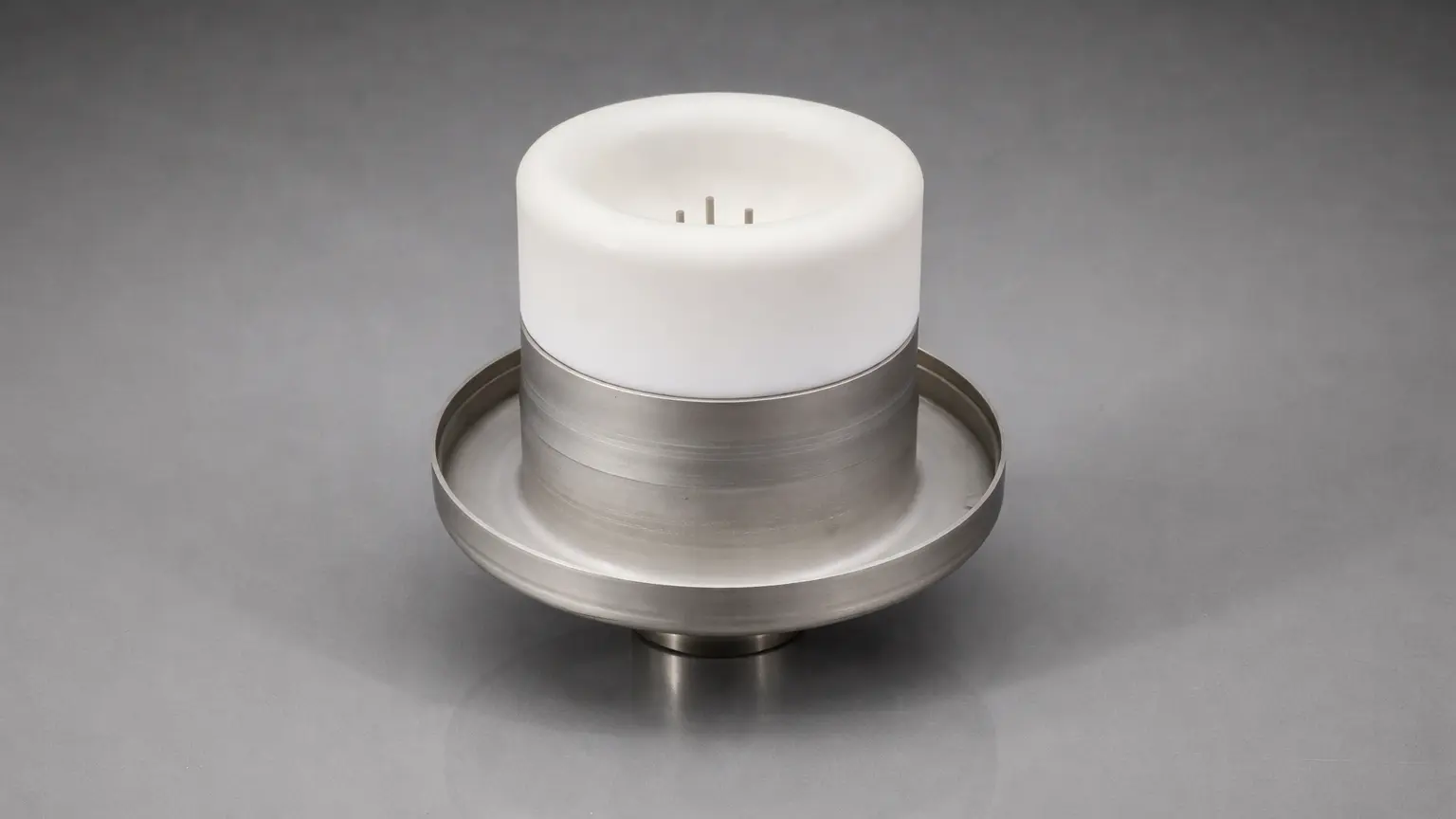
Ceramic-to-metal feedthroughs are vital for diagnostic windows (Ref: ITER Official Diagnostics Overview), RF heating antennas, and breeder blanket penetrations. The typical configuration involves $Al_2O_3$ or $SiC$ ceramics brazed to 316L stainless steel or vanadium alloys. Fusion ceramic brazing is performed under high vacuum ($<10^{-3}$ Pa) at temperatures between 900°C and 1100°C to ensure chemical metallurgical bonding while inhibiting excessive brittle phase growth.
3.Enhancing Thermal Shock and Radiation Resistance
During plasma discharges, components undergo transient thermal shocks. Engineers utilize several key strategies to improve durability:
- Low-Modulus Buffering: Employing porous copper or molybdenum interlayers.
- Multi-Layer Brazing: Creating an "active gradient" to release residual stress iteratively.
- Interface Refinement: Utilizing Zr/Hf active element modifications.
Compared to traditional AgCuTi systems, CuZr and TiZrHf fillers exhibit lower swelling rates and superior interface stability post-irradiation. Zr/Hf promotes the formation of fine, dispersed carbides that arrest crack propagation and reduce tritium retention. Recent data indicates that $SiC$ joints brazed with CuZrNb retain a shear strength of $>150$ MPa even after simulating 1 dpa (displacements per atom) of neutron damage.
4.Real-World Case Study: ITER Diagnostics
A significant success involves the ITER diagnostic window assemblies. By employing $Al_2O_3$/316L joints with CuTiZr active brazing, engineers achieved a shear strength of $>220$ MPa and a helium leak rate of $<5 \times 10^{-10}$ Pa·m³/s. These assemblies passed accelerated irradiation tests ($E > 0.1$ MeV) without performance degradation. As CFETR and commercial fusion reactors move toward construction, the reliability of high-radiation ceramic insulators will remain a key metric for fusion energy feasibility.